India's Cancer Burden: Tobacco and Delayed Detection
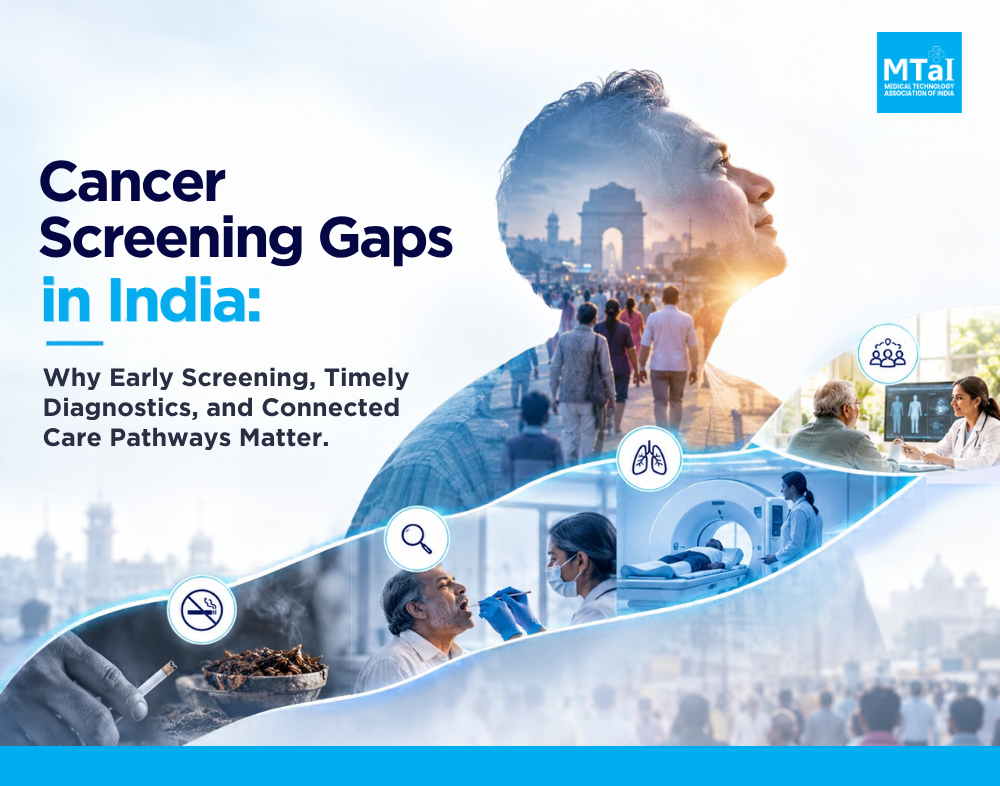
Cancer Screening Gaps in India: The Tobacco Burden and the Cost of Late Detection
India’s battle against cancer is rapidly turning into a race against time. While technological advancements continue to refine diagnostic precision and therapeutic efficacy, a vast majority of patients enter the healthcare delivery system only after their disease has reached advanced stages. This common pattern of late presentation severely reduces clinical intervention options, increases treatment complexity, and places an overwhelming financial and emotional strain on families.
The widespread usage of tobacco makes this challenge exceptionally acute. Data from the World Health Organization’s Global Adult Tobacco Survey (GATS-2) reveals that 28.6% of Indian adults, representing nearly 267 million individuals, consume tobacco in various forms. Both smoked and smokeless variants drive the nation’s severe oncology burden, particularly in malignancies of the oral cavity and respiratory system. Yet this heavy exposure to a known carcinogen seldom prompts timely screening, and by the time symptoms bring patients to a clinic, the window for early cure has often closed. Bridging this disconnect demands a structured, multi-pronged framework that integrates tobacco cessation, risk-stratified screening, advanced diagnostics, and seamless referral pathways.
The Tobacco Burden: A Preventable Risk with Lasting Consequences
Tobacco remains India’s most significant preventable cancer risk factor. In Western markets, cigarette smoking dominates consumption. India, by contrast, faces a dual challenge: smoking and smokeless tobacco, which includes products like gutkha, zarda, gudakhu and khaini. This distinction is critical for public health policy. While smoking correlates directly with pulmonary malignancies, smokeless forms dramatically elevate the incidence of head and neck cancers, specifically oral cavity carcinomas. Consequently, policy interventions cannot treat tobacco exposure as a uniform behavioral pattern; they must address both modes of consumption with tailored strategies.
India has achieved commendable progress through public awareness, policy mandates, and cessation drives. However, addressing the vast population with prior exposure requires measures extending far beyond basic prevention. Even individuals who successfully quit retain an elevated carcinogenic risk for years, governed by their cumulative exposure history. While tobacco cessation curtails future risk, systematic screening and early diagnosis address existing cellular anomalies. Both are irreplaceable pillars of a comprehensive national cancer control strategy.
The Screening Gap: Bridging Risk and Early Clinical Intervention
India possesses an established operational framework for population-based screening targeting oral, breast, and cervical cancers among adults aged 30 and above. Nevertheless, the divide between policy design and ground-level participation remains stark. National Family Health Survey (NFHS-5) data indicates that a mere 1.2% of men and 0.9% of women have ever undergone oral cancer screening, with similarly negligible coverage for breast and cervical cancers. While these figures serve as a historical baseline, they starkly illustrate the scale of the implementation challenge.
A confluence of systemic and socio-economic barriers perpetuates this gap. Limited awareness regarding early warning signs, clinical hesitance, geographical distance from diagnostic centers, and high out-of-pocket expenditure routinely postpone initial consultations. Furthermore, early-stage malignancies often remain asymptomatic, allowing undetected progression. This is particularly tragic in oral cancers, where suspicious pre-cancerous lesions are visually accessible during basic clinical examinations yet remain uninvestigated. The landmark community trial in Kerala provided decisive evidence on this front, demonstrating that routine visual oral screening by trained healthcare workers significantly reduced mortality among high-risk tobacco and alcohol users. The imperative is clear: identifying vulnerable cohorts and connecting them to organized screening yields substantial public health dividends.
The Diagnostic Gap: Transitioning from Suspicion to Timely Confirmation
Screening merely marks the entry point of the oncology continuum. A suspicious clinical finding must immediately trigger specialist evaluation, confirmatory testing, staging, and evidence-based therapeutic planning. Here, medical technology serves as a vital enabler. For oral oncology, while visual inspection remains the primary line of evaluation, digital imaging tools and validated AI-assisted triaging systems can document suspicious lesions, standardized scoring, and facilitate remote specialist referrals in resource-constrained settings. However, these digital aids complement-rather than replace-biopsy and histopathological confirmation.
In lung cancer management, low-dose computed tomography (LDCT) offers a transformative avenue for early intervention. Global evidence, reaffirmed by the International Agency for Research on Cancer (IARC), confirms that LDCT screening in well-defined high-risk populations significantly curtails lung cancer mortality and late-stage presentation. For India, deploying LDCT requires a balanced approach that accounts for demographic risk profiles, radiological infrastructure, clinical capacity, and health economics, backed by clear protocols to manage incidental pulmonary nodules without overburdening the system. Parallel advancements in digital pathology, molecular diagnostics, and biomarker testing are further refining tumor characterization, enabling personalized treatment pathways. The ultimate value of these technologies lies not in their complexity, but in empowering clinicians to make definitive decisions much earlier in the patient journey.
The Continuity Gap: Connecting Early Detection Directly to Care
A screening initiative cannot be evaluated solely by the volume of individuals examined. Its true clinical utility hinges on the proportion of screen-positive patients who receive timely diagnostic confirmation and active treatment. This distinction is critical in decentralized healthcare settings where patients must navigate disparate facilities for consultations, imaging, pathology, and tertiary care. Every additional administrative or logistical hurdle risks delays, financial exhaustion, and loss to follow-up.
An optimized care model requires seamless integration across primary healthcare centers, district hospitals, and tertiary oncology hubs via structured referral networks. Interoperable digital health records, telepathology, and virtual specialist consults can bridge urban-rural diagnostic divides, bringing expert evaluation to the patient rather than forcing burdensome travel. While advanced medical equipment streamlines diagnostic workflows, technology alone is insufficient without trained personnel, regular calibration, quality assurance, and accountable referral channels. For the patient, healthcare must operate as a unified, continuous corridor rather than a fragmented series of appointments.
The Way Forward: Prioritizing Outcomes Over Activity
India’s cancer control paradigm must decisively shift toward downstaging diagnoses, particularly within high-risk populations. This requires scaling up tobacco cessation services alongside risk-stratified screening, expanding access to validated diagnostic tech, and tightening referral coordination between primary care and specialized oncology centers. Crucially, success metrics must evolve. Rather than tracking raw screening volumes, performance should be measured through meaningful clinical indicators: screening uptake among eligible cohorts, post-screening diagnostic confirmation rates, time-to-treatment initiation, and the ratio of early- versus late-stage diagnoses.
The economic arguments for this pivot are equally compelling. Managing late-stage cancer demands intensive, multi-modal therapies that place an immense financial burden on households and state infrastructure alike. Early detection creates opportunities for less invasive, highly cost-effective interventions. India’s opportunity lies in building a resilient MedTech and healthcare ecosystem where prevention, technology, and clinical expertise synergize. The true measure of national progress will not be our capacity to treat end-stage disease, but our ability to detect it before treatment becomes an uphill battle. Closing the screening gap is not merely a diagnostic goal; it is the cornerstone of an equitable, sustainable healthcare future.